
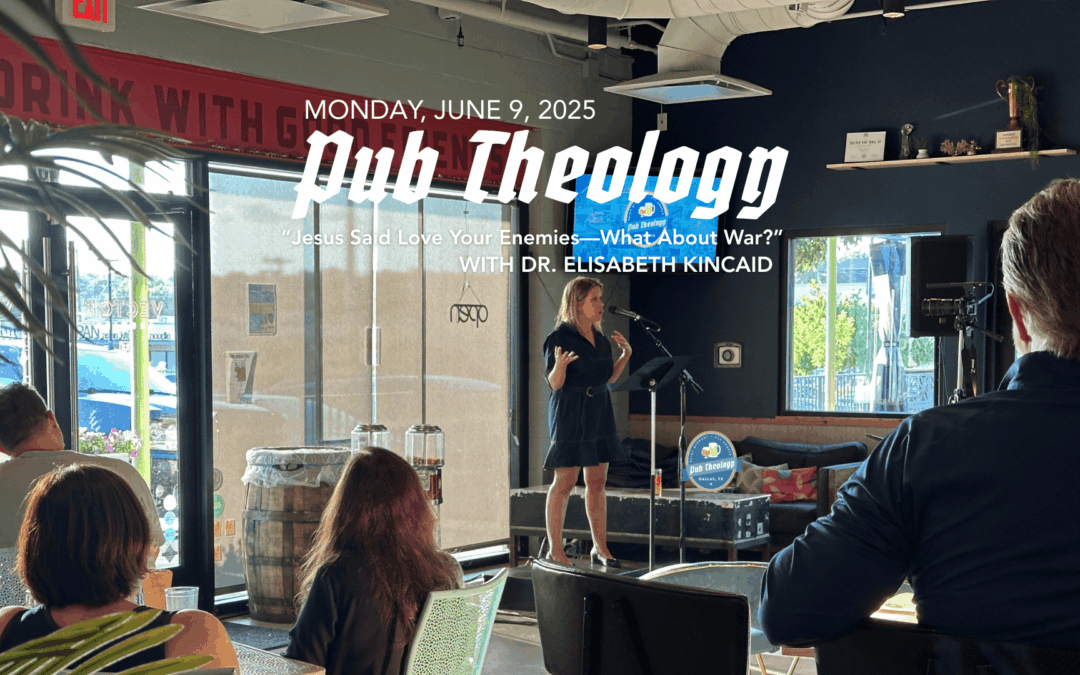
Last Monday, we welcomed Dr. Elisabeth Kincaid for the second night of our Pub Theology series, tackling one of the most difficult questions in Christian ethics: How do we reconcile Jesus’ command to “love your enemies” with the reality of war?
Dr. Kincaid, a theologian with deep expertise in ethics and church history, led an insightful and thought-provoking conversation that challenged us to wrestle with the tensions between faith, morality, and the realities of conflict.
Missed it? Watch the full talk here:
Key Takeaways from the Talk
The Complexity of Dietrich Bonhoeffer’s Legacy
Dr. Kincaid began by discussing the life of Dietrich Bonhoeffer, the German pastor and pacifist who ultimately became involved in a plot to assassinate Hitler. Bonhoeffer wrestled deeply with his convictions, unsure if he was making the right choice but stepping forward in a situation “so far outside normal” that he felt compelled to act. His story reminds us that faith often demands difficult decisions amid immense personal sacrifice — and that sometimes there are no perfectly clear answers.
Biblical Foundations and the Limits of Scriptural Answers
On the contentious topic of Israel and Palestine, Dr. Kincaid emphasized that biblical texts do not provide straightforward answers for modern geopolitical solutions like the two-state solution. Instead, Christians, Jews, and Muslims alike are called to pursue justice and peace, expanding their imaginations beyond scarcity to embrace God’s abundance.
The Role of the Church in Public Discourse
Dr. Kincaid highlighted the importance of the church’s voice in speaking truth to power and advocating for justice — as seen historically in the Confessing Churches in Nazi Germany and the Black Church during the Civil Rights Movement. However, she cautioned that the church is often not equipped to provide specific political solutions and should instead focus on prophetic witness.
Christian Nationalism as a Theological Error
Addressing current political discourse, Dr. Kincaid was clear: Christian nationalism is a heresy. While Christians are called to live out their faith in public life, the idea of a “Christian nation” conflates earthly governments with God’s kingdom — a distinction that must be maintained.
Wrestling with the Old and New Testament God
The talk tackled the perceived contradiction between the Old Testament’s “God of war” and the New Testament’s “God of love,” identifying this view as a heresy known as Marcionism. Dr. Kincaid invited listeners to read the Bible holistically, understanding the Old Testament’s context and how it foreshadows the New Testament’s message of inclusion and love through Jesus.
The Ethics of War in a Modern Age
Dr. Kincaid explored the just war tradition, emphasizing that if war is to be justified, it must be undertaken seriously as a commitment to peace, with strict attention to proportionality and minimizing harm. Modern technologies like drones and nuclear weapons heighten the moral stakes, requiring even greater care and reflection. She also noted the unique role of army chaplains as noncombatants dedicated to spiritual care in the midst of war.
Loving Enemies in the Context of "Just War"
Finally, she addressed how just war proponents interpret Jesus’ teachings about loving enemies. The commitment to peace can involve the painful reality of going to war to protect the vulnerable and uphold justice — a sacrifice undertaken out of a profound seriousness about peace. This approach, however, remains controversial and unconvincing to many Christian pacifists.
This night of Pub Theology reminded us that faith and ethics often dwell in tension rather than easy answers. We invite you to reflect on these questions, engage with your community, and consider how Jesus’ call to love even our enemies shapes how we live in a conflicted world.


