
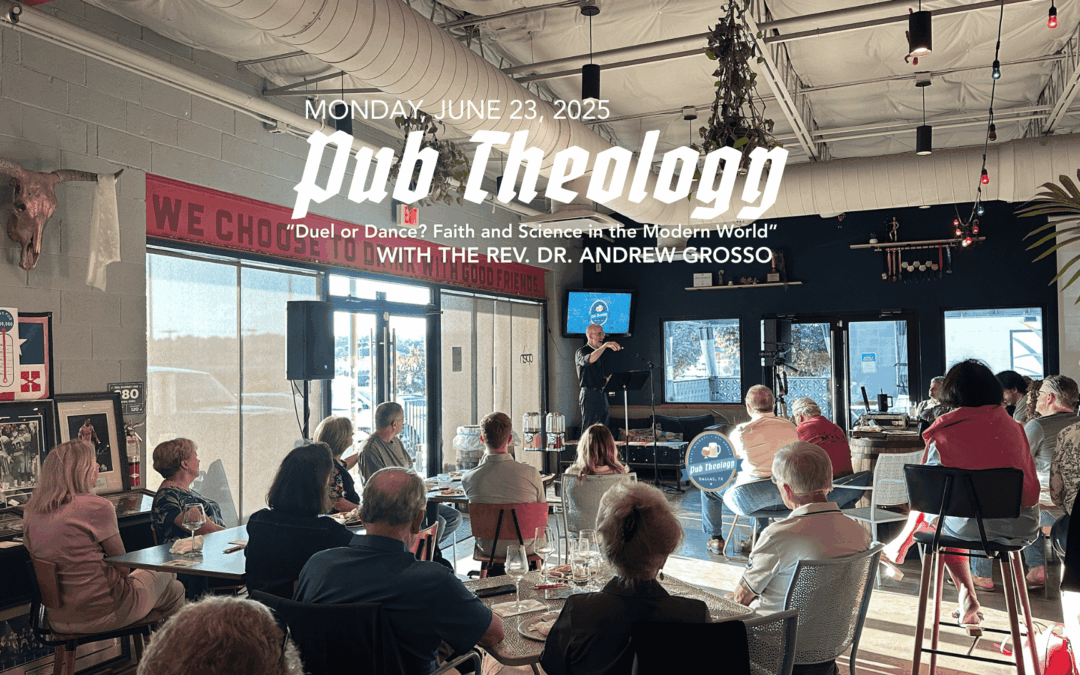
On the final night of our Pub Theology series, the Rev. Dr. Andrew Grosso guided us through a compelling and accessible exploration of the relationship between faith and science. The discussion unfolded in three main parts, each offering fresh insights into why this topic matters and how we might rethink longstanding assumptions.
Missed it? Watch the full talk here:
1. Is the Relationship Between Faith and Science Relevant to Our Daily Lives?
The Rev. Dr. Andrew Grosso began by addressing a fundamental question: Is the faith-science conversation simply an abstract academic debate, or does it have real meaning for our everyday lives? He emphasized that the relationship between faith and science is deeply embedded in how we understand ourselves, the world, and our purpose. From moral choices to how we approach technology, medicine, and environmental stewardship, questions at the intersection of faith and science impact us all. Both science and theology are contemplative disciplines that shape not only knowledge but the way we live and relate to others.
2. Why Has the Relationship Between Faith and Science Been Seen as Problematic?
Next, the Rev. Dr. Andrew Grosso explored common ways this relationship has been framed as a conflict. He outlined three recurring critiques often exchanged between science and faith communities:
- Critique of Knowledge: Science challenges faith by questioning whether religious claims qualify as “real” knowledge, while faith questions whether science fully accounts for human experience.
- Human Identity and Meaning: Both science and faith wrestle with what it means to be human, each claiming insights into our dignity and destiny.
- Historical and Philosophical Issues: Questions about how we got here and why often lead to deeper metaphysical disagreements.
Interestingly, these critiques mirror each other—science and faith are essentially addressing the same fundamental questions from different angles, which has sometimes led to misunderstandings and unproductive “proxy wars.” Rev. Dr. Andrew Grosso stressed that the tension arises largely because of how the problem is characterized, not because the problem itself is irresolvable.
3. Rethinking the Nature of the Problem
Drawing on philosopher Alvin Plantinga, Rev. Grosso reframed the discussion by pointing out that the real tension is not between faith and science themselves, but between naturalism (the worldview that denies anything supernatural) and religious belief. Science as a method is neutral and has no inherent opposition to spirituality; problems arise when naturalism co-opts scientific findings to make sweeping philosophical claims.
This misunderstanding has caused many to misapply scientific findings as if they could answer moral, spiritual, or existential questions, or conversely, to demand that religious texts function as scientific manuals. Rev. Grosso encouraged us to recognize that many of the questions at stake are inherently religious or philosophical and cannot be fully resolved by empirical methods alone.
The Christian Doctrine of Creation: The Foundation for Science
Finally, the Rev. Dr. Andrew Grosso proposed that the Christian doctrine of creation offers the key to understanding why science is not only possible but necessary. According to this doctrine, the world is God’s good creation—real, ordered, and autonomous enough to be explored through empirical investigation. Because the world is distinct yet related to God, science can study nature freely without conflicting with faith.
This theological vision supports a harmonious relationship where faith invites scientific inquiry as a way to steward and understand creation more deeply. It calls us to embrace the unity of truth, recognizing that empirical, moral, aesthetic, and spiritual dimensions of reality intersect and inform one another.
Final Thoughts
The Rev. Dr. Andrew Grosso’s talk illuminated how the dialogue between faith and science is vital, complex, and richly rewarding. Rather than a duel, it’s a dance that invites us into deeper questions about knowledge, meaning, and our place in the cosmos. By rethinking the problem and grounding science in a robust theological framework, we can move beyond conflict and toward mutual enrichment.


