A Message from the Rector, the Rev. Dr. Christopher D. Girata
A few years ago, I asked the clergy of Saint Michael to help me answer a big question: What does a well-formed disciple at Saint Michael look like? Jesus calls each of us to a life of discipleship, but how we respond to that call and how we are transformed looks different depending on who we are, where we live, and what the world needs.
Asking how to identify “a well-formed disciple” was born out of years of experience with families in crisis. Most people are polite about their faith most of the time. Some people go to church every week, some only come occasionally. Some read and study the Bible, some pray regularly, some serve the most vulnerable in the world, and so on. Each person who claims to be Christian responds to God differently, but only some allow their response to fundamentally shape them.
Often, it’s only when crisis hits—when we are brought to our knees—that we know just how impactful our Christian commitment has been. Priests often get a clear sense of just how deeply the life of faith has gone for people by witnessing the way they respond to a crisis. I’ve been in many crisis situations where the response has been incredibly faithful, when people have faced the scariest situations with a calmness borne out of the deep well of faith they’ve formed with God. In other situations, people respond with desperation and confusion, completely unmoored from any sense of faith or trust in God. It’s my hope that as a church community, we will lovingly encourage one another to be transformed into the former.
There are countless ways to be shaped into a well-formed disciple. The church has hundreds of examples of saintly people who have lived lives that can point us toward God in profound ways. My question was less about the theoretical or intellectual ideas of discipleship, and more about the tangible way our church can and should shape disciples right here in North Dallas. Healthy discipleship should transform us over time so we can help transform the world for Christ, and I knew our amazing clergy could help me define what that looked like.

Through months of conversations, our clergy thoughtfully vetted many facets of discipleship. We agreed to anchor our understanding of discipleship in the baptismal covenant. In addition to the fundamental creed of the church, the baptismal covenant asks us to make specific commitments:
- Will you continue in the apostles' teaching and fellowship, in the breaking of the bread, and in the prayers?
- Will you persevere in resisting evil, and, whenever you fall into sin, repent and return to the Lord?
- Will you proclaim by word and example the Good News of God in Christ?
- Will you seek and serve Christ in all persons, loving your neighbor as yourself?
- Will you strive for justice and peace among all people, and respect the dignity of every human being?
To each question, we reply, “I will, with God’s help.” We pledge to strive toward the transformation promised in baptism “with God’s help,” and we find much of that sacred help right here in this church community.
Syncing our baptismal covenant with our shared experience helped us create a clear structure to guide our discipleship formation. Here at Saint Michael, we have defined and adopted four pillars of discipleship: pray, learn, serve, give. Each pillar is an extension of a healthy discipleship identity, and each provides a way to both assess our discipleship identity and point us in the direction of growth.
The first two pillars are ones we experience most on a typical Sunday. Through prayer, we deepen our relationship with God as we engage with him in our daily lives. God reveals the great work He is doing in our lives and in the world, and invites us to join Him in that work. Learning is a lifelong journey as we recognize more and more how the Gospel touches every part of our lives. We discover how Jesus invites us to know the truth that sets us free by studying the traditions, teachings, and practices of the Bible and of the Church.
The last two pillars are ones we experience within the rhythm of our communal life. Just as Jesus came to us in the form of a servant, we are called to love and serve others. By helping those in need, we grow spiritually and are transformed as we develop virtues such as humility, patience, and compassion. Serving also fosters a sense of purpose and fulfillment, as we experience the joy of making a positive impact in the lives of others. Generously giving our material wealth helps to define our identity toward the priorities of God and away from the priorities of the world.
We are transformed as we commit to true growth along the paths of discipleship. This fall, we are challenging each member of our church community to make explicit commitments toward service and giving. You will have the opportunity to invest yourself in ways that will yoke your growth to God in Christ right here at Saint Michael.
As always, this fall you will be asked to make a financial commitment of support for our shared mission and ministry in 2026. This is nothing new and is critically important to our discipleship. The world teaches us that we should gather as much material wealth as possible to increase our security and keep control. Yet Jesus tells us that the promises of the world—power, security, and control—are fleeting lies. Instead, Jesus offers us a new way of being that places our dependency on God. By giving away that which the world says is most valuable—money—we commit ourselves to the new life God promises.
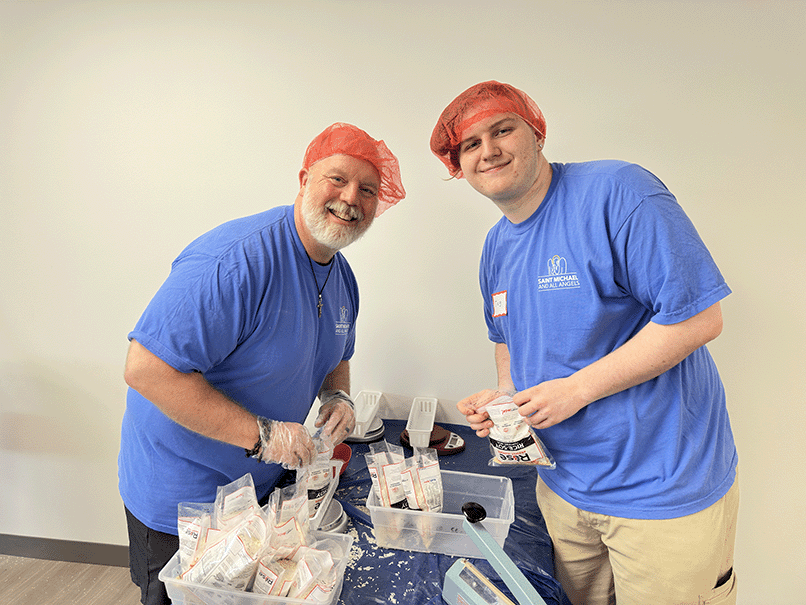
For the first time, we will also be asking you to make an explicit commitment of service. As disciples, Jesus calls us to love God and to love our neighbor as ourselves, and that means committing to use the gifts we have to help others. Our gifts can be used in many ways, both inside and outside our church community.

When we commit to serve, we commit our gifts to one another. This year, your gifts may be best used inside our walls to do things like help support worship, teach children, or care for the sick. Or perhaps this year, your gifts may be best used outside our walls to provide food to the hungry or hope for the hopeless. Whether inside or outside our walls, service is a transformative part of our discipleship. I want you to think about your gifts and how you can put them to use and then get ready to make an explicit commitment to service this year.
Together at Saint Michael, we are creating a new culture of opportunity, accountability, and transformation. When we commit to discipleship and encourage our neighbors to commit with us, we change the world. The pledge to give and serve in ways that will transform us in the future help us extend God’s kingdom right here and now. We are wonderfully made by God and worthy of unconditional love. Let us boldly commit to investments that challenge us to grow in powerful ways and then let’s celebrate how the Spirit works to change the world through us!

**This article was written by the Rev. Dr. Christopher D. Girata and was featured in the 2025 Fall Archangel.
Read More Featured Archangel Articles

The Ministry of Lay Chaplaincy: Reflections from the Bedside
The Four Pillars of Discipleship
All Angels Legacy

Women of Saint Michael
This year, we gather as the Women of Saint Michael around a shared goal: Becoming Better Equipped—Together.

Darin Kinder: Discovering God’s Purpose in the Aftermath of 9/11
September 11, 2001, is a day that changed everything. All of us can remember where we were when we heard the news.